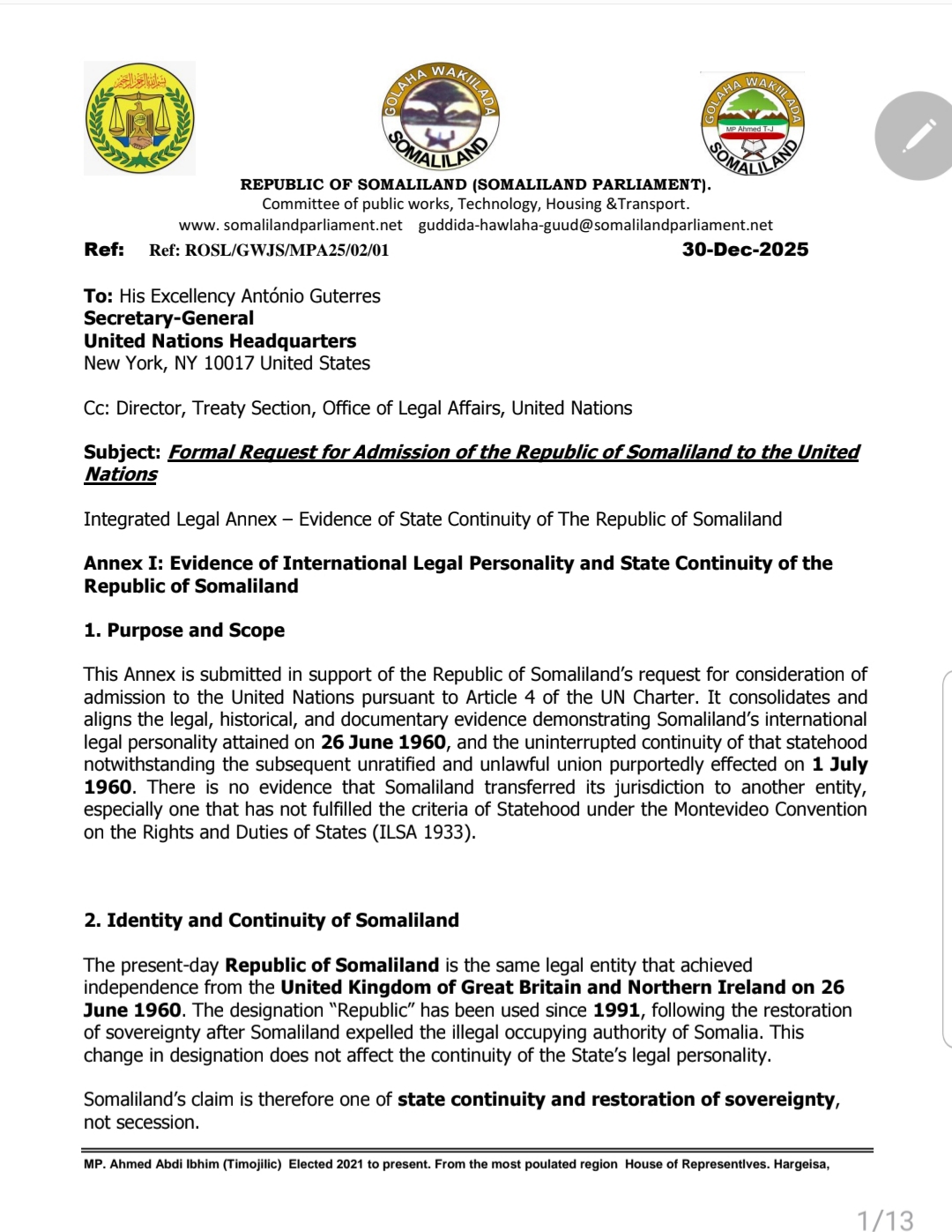
GoSL Presidential Support on 23 Sep. 2026 New York Your Excellency Mr. President this is: - TO: The Secretary-General United Nations New York SUBJECT: FORMAL REQUEST FOR THE PRIMARY DOCUMENTARY RECORD ESTABLISHING THE LEGAL UNION, TRANSFER OF JURISDICTION, AND SUCCESSION CONCERNING THE STATE OF SOMALILAND ON 1 JULY 1960 I write to request a formal documentary clarification from the United Nations concerning the primary legal record upon which the United Nations has subsequently described the events of 26 June–1 July 1960 as the establishment of the Somali Republic through a merger between the former British Somaliland Protectorate and the former Trust Territory of Somaliland under Italian administration. This request is not a request for a historical narrative or a repetition of later institutional descriptions. It concerns the primary legal instruments, agreements, acts of acceptance, notifications, registrations, and contemporaneous United Nations records by which the alleged union and its territorial consequences were legally affected and subsequently recognized in the international record. I. THE DOCUMENTARY QUESTION The United Nations Treaty Series contains No. 5349, an Exchange of Letters between the United Kingdom and the Government of Somaliland dated 26 June
1
9
6
0. The instrument expressly contemplated that, should the Government of Somaliland become party to an agreement or instrument: “Transferring, or confirming the transfer of, jurisdiction over the territory of the Government of Somaliland, to any other Government” that agreement or instrument would provide for the transfer and acceptance by that other Government of specified obligations of the Government of Somaliland. The agreement therefore identifies a specific future legal act concerning the transfer or confirmation of transfer of jurisdiction over the territory of Somaliland. It does not itself identify the Government of Somalia as the transferee and does not itself constitute the contemplated subsequent transfer instrument. The agreement is registered and published in the United Nations Treaty Series. Accordingly, the central documentary question is: Where is the subsequent agreement, treaty, instrument, act of acceptance, or other legally operative document by which jurisdiction over the territory of the independent State of Somaliland was transferred, or the transfer confirmed, to the Government that became the Somali Republic on 1 July 1960? II. THE REQUIREMENT FOR RECIPROCAL STATE ACTION The documentary record must distinguish between:
1. an agreement or act adopted by Somaliland;
2. an agreement or act adopted or accepted by Somalia;
3. any instrument establishing the new State or constitutional union;
4. any instrument transferring or confirming territorial jurisdiction;
5. any notification to the United Nations;
6. any registration under Article 102 of the Charter;
7. any notification to treaty depositaries;
8. any contemporaneous recognition or acceptance by third States; and
9. any subsequent United Nations document identifying the primary instrument upon which its characterization was based. If the legal proposition is that two previously distinct political entities became one State through a merger, the documentary record should identify the legal acts by which each side consented to, accepted, or otherwise brought that merger into legal effect. A later description that a “merger” occurred is not itself the original instrument establishing that merger. III. THE 1960 UNION INSTRUMENT The Somaliland Union Law of 1960 contains operative language stating that representatives of the State of Somaliland and the State of Somalia, acting with authority on behalf of their respective States and peoples, agreed that the two States would unite in a new independent republic. That document is therefore material evidence and should be examined together with the corresponding Somali-side constitutional, legislative, executive, or diplomatic record. Accordingly, I respectfully request that the United Nations identify and provide, or identify the archival location of: A. The original or certified copy of the instrument adopted by Somaliland concerning the union; B. The corresponding original or certified copy of the instrument adopted, accepted, ratified, or otherwise approved by the Government or competent authority of Somalia; C. Any instrument signed or exchanged between the two Governments establishing the union; D. Any instrument expressly transferring or confirming the transfer of jurisdiction over the territory of Somaliland to the new Republic; E. Any instrument defining the territorial extent of the new Republic, including the status of the territory formerly constituting the independent State of Somaliland; F. Any notification by Somaliland or Somalia to the Secretary-General concerning the union, merger, transfer of jurisdiction, or succession; G. Any contemporaneous communication from the United Kingdom, Italy, Somaliland, or Somalia transmitting such an instrument to the United Nations; H. Any Security Council, General Assembly, Trusteeship Council, or Secretariat document that identifies the original legal instrument establishing the claimed merger. IV. THE UNITED NATIONS SECRETARIAT'S OWN SUCCESSION RECORD The Secretariat's memorandum A/CN.4/150, dated 10 December 1962, was prepared specifically to provide an account of State practice and the practice of the Secretary-General concerning succession to treaty rights and obligations. The Somalia section contains separate treatment of treaty relations applicable to the former Italian Trust Territory and to the former British Somaliland. The memorandum is therefore particularly important to the present inquiry. I request that the United Nations identify the complete documentary basis underlying the Somalia section of A/CN.4/150, including all original correspondence, notifications, exchanges of letters, memoranda, and archival documents upon which the Secretariat relied. In particular, I request clarification of the documentary basis for the Secretariat's treatment of: (1) the former Trust Territory of Somaliland under Italian administration; (2) the former British Somaliland; (3) succession to treaty rights and obligations relating separately to those two territories; and (4) the legal basis upon which treaty relations concerning the two territories were subsequently treated as relations of the Republic of Somalia
V. THE 1970 SECRETARIAT CHARACTERIZATION A later Secretariat study, A/CN.4/225, paragraph 97, states that on 1 July 1960: “an independent State of Somalia was established as a result of a merger between the former Trust Territory of Somaliland under Italian administration ... and the former British Somaliland Protectorate...” This statement is important, but because it was made in a 1970 Secretariat study, ten years after the events in question, it should be distinguished from the primary legal instrument that allegedly produced the merger. The UN's own catalogue identifies A/CN.4/225 as the seventh study prepared by the Secretariat on succession of States to multilateral treaties. I therefore respectfully request that the United Nations identify: the precise contemporaneous primary document or documents upon which paragraph 97 of A/CN.4/225 based its statement that the Somali Republic was established “as a result of a merger” involving the former British Somaliland Protectorate. If the source was: • a treaty; • an agreement; • an exchange of letters; • an Act of Union; • legislation; • a constitutional instrument; • diplomatic correspondence; • a declaration; • a notification; • a Security Council document; • a General Assembly document; • a Trusteeship Council document; or • another contemporaneous State instrument, I respectfully request its exact document number, date, parties, archival location, and complete text. VI. THE CRITICAL DOCUMENTARY GAP The question is not whether later United Nations publications describe the two territories as having become part of Somalia. The question is: What original legal instrument established that result? In particular: Where is the instrument contemplated by the 26 June 1960 UK–Somaliland Agreement that transferred, or confirmed the transfer of, jurisdiction over the territory of Somaliland to another Government? If the United Nations possesses that instrument, I respectfully request its production or precise archival identification. If the United Nations does not possess it, I respectfully request that this be expressly stated. If the United Nations relies upon another document instead, I respectfully request identification of that document and an explanation of its legal relationship to the instrument contemplated by UNTS No.
5
3
4
9. VII. REGISTRATION AND ARTICLE 102 OF THE UN CHARTER I further request a complete search of the United Nations Treaty Collection and Secretariat archives for any instrument concerning: • transfer of jurisdiction over Somaliland; • confirmation of such transfer; • union between Somaliland and Somalia; • merger of Somaliland and Somalia; • succession by Somalia to rights and obligations of Somaliland; • territorial incorporation of Somaliland into the Somali Republic; or • acceptance by Somalia of jurisdiction over the territory of the former independent State of Somaliland. The request includes documents registered under Article 102 of the Charter, documents submitted for registration but not registered, documents communicated to the Secretariat without registration, and relevant archival correspondence. Article 102 requires treaties and international agreements entered into by UN Members after the Charter's entry into force to be registered and published, and provides consequences concerning reliance upon an unregistered treaty before a UN organ. I therefore request that the Secretariat distinguish clearly between: (a) an instrument that existed but was not registered; (b) an instrument communicated to the Secretariat but not registered; (c) an instrument registered and published; (d) an instrument referred to retrospectively but whose original has not been located; and (e) a later Secretariat characterization for which the underlying primary instrument has not been identified. VIII. REQUEST FOR A DOCUMENTARY DETERMINATION I respectfully request the Secretary-General, through the appropriate United Nations legal and archival authorities, to provide a documentary response addressing the following questions:
1. What is the original legal instrument establishing the union between the independent State of Somaliland and the State of Somalia?
2. Where is the corresponding act of acceptance, approval, ratification, or other legally effective act by the Somali side?
3. What instrument legally transformed the two States into the new Republic described as the Somali Republic?
4. What instrument transferred, or confirmed the transfer of, jurisdiction over the territory of Somaliland to that Republic?
5. What document establishes the territorial extent of that transfer?
6. Was that instrument transmitted to the United Nations?
7. Was it registered under Article 102 of the Charter?
8. If not registered, was it otherwise deposited, communicated, archived, or relied upon by the Secretariat?
9. What contemporaneous UN document records acceptance of the territorial consequence of the alleged merger?
1
0. What primary document supports the statement in A/CN.4/225, paragraph 97, that the Somali Republic was established “as a result of a merger” between the two territories?
1
1. Does the United Nations possess the original document contemplated by UNTS No. 5349 concerning transfer or confirmation of transfer of jurisdiction over the territory of Somaliland?
1
2. If that document cannot be located, will the United Nations identify the documentary basis upon which the subsequent characterization of the territorial consequence was made? IX. REQUEST FOR PRESERVATION AND DISCLOSURE OF THE ARCHIVAL RECORD Given the significance of these documents to the international legal record concerning State succession, treaty succession, territorial jurisdiction, and United Nations membership, I respectfully request that all relevant archival materials be preserved and that the United Nations identify the appropriate archival series and reference numbers for: • Security Council files; • General Assembly files; • Trusteeship Council files; • Secretary-General correspondence; • Office of Legal Affairs records; • Treaty Section records; • International Law Commission working papers; • records relating to A/CN.4/150; • records relating to A/CN.4/225; • registration files; • communications received from the United Kingdom; • communications received from Italy; • communications received from Somaliland; • communications received from Somalia; and • any file containing the original instrument establishing or confirming the alleged transfer of jurisdiction. X. CONCLUSION This request is directed to the primary documentary record, not to a political interpretation of subsequent events. The essential evidentiary chain is: agreement → acceptance → legally operative union instrument → territorial consequence → transfer/confirmation of jurisdiction → notification/registration → contemporaneous United Nations record. Where a document exists, its identification should resolve the issue. Where a document does not exist in the United Nations record, that absence should be expressly recorded. Where a later United Nations publication makes a legal or historical characterization, the primary source upon which that characterization rests should be identifiable. I therefore respectfully request a formal documentary response identifying the instruments, archival references, registration records, and contemporaneous evidence upon which the United Nations bases its present treatment of the legal status and territorial consequences of the events of 26 June–1 July
1
9
6
0. I. Executive Legal Summary: The Premise of the "Failed Union" According to Section 6 ("Legal Case of Somaliland") of the official Country Profile, the geopolitical union intended between the independent State of Somaliland and the Trust Territory of Somaliland under Italian administration on 1 July 1960 was legally defective at its inception, was never validly ratified under international or domestic law, and ultimately aborted. The primary legal and political elements detailing this failure include: II. Chronological Breakdown of the Legal Failure (1960–1969)
1. Prior Intent vs. The Non-Existent International Treaty (June 1960) • The Original Agreement: Prior to independence on 26 June 1960, representatives of both territories agreed that an Act of Union would be negotiated, signed by both sovereign states upon their respective independence dates, and serve as a binding international treaty between two distinct entities. • Somaliland’s Unilateral Action: On 27 June 1960 (one day after gaining independence from Great Britain), the Legislative Assembly of Somaliland drafted and passed its own version—the Union of Somaliland and Somalia Law. This document was intended to be jointly reviewed, amended, and signed alongside Somalia’s representatives upon their independence. • Somalia’s Unilateral Counter-Act: Instead of reviewing or signing Somaliland's law, the Southern Legislative Assembly convened separately on 30 June 1960 and passed an entirely different document written in Italian, titled Atto di Unione (Act of Union).
2. The Unlawful Merger of 1 July 1960 • Absence of a Dual-Signed Instrument: On 1 July 1960, the two assemblies convened jointly without ever having signed a unified Act of Union or bilateral agreement. • The Presidential Decree Defect: On the same day, the newly elected provisional President issued a decree-law attempting to formalize the union. However, this decree-law was never converted into law by the joint assembly as required by constitutional procedure.
3. Formal Legal & Scholarly Evaluations of Nullity The Country Profile explicitly cites legal scholars and expert observations confirming that no valid legal union ever took place: • Paolo Contini’s Assessment: Noted that the Union of Somaliland and Somalia Law passed in Hargeisa had no legal force in the South (Somalia), while the approval "in principle" of the Atto di Unione in Mogadishu was insufficient to make it legally binding across both territories. • Eugene Cotran’s Analysis (The Law of Marriage and Divorce):
1. Both the Somaliland Law and Somalia Act of Union were drafted as bilateral agreements, but neither document was ever signed by authorized representatives of both territories.
2. The Union of Somaliland and Somalia Law purported to derogate in several aspects from the draft Constitution.
3. The Somalia Act of Union was only partially approved "in principle" and was never formally enacted into law.
4. The Presidential Decree-Law of 1 July 1960 never took effect because it was never ratified into law in accordance with constitutional provisions.
4. Retrospective Attempt at Legitimization (January 1961) • Realizing the legal invalidity of the arrangement, a new retroactive "Act of Union" was pushed through the Southern-dominated National Assembly on 31 January 1961—seven months after the fact. • The document violated the standard international legal principle against ex post facto / retroactive legislation and failed to cure the initial lack of dual consent at the moment of statehood.
5. Political Marginalization & The Rejection Referendum (1961) • Political Disproportion: Somaliland never entered the existing Somalia Human Resource arrangement, FGOS or Somali Republic or Somalia at this and under this severe disadvantage. Parliamentary seats are allocated at a (Dir IN 7regions to 1 share where the rest has
3.5 shares, quantified ) 4:1 ratio (99 seats for the South vs. 33 seats for Somaliland). All major executive positions—including the President, Prime Minister, Speaker of Parliament, Chief Justice, and heads of the military branches—were seized by Southern politicians. • Rejection of the 1961 Constitutional Referendum: In June 1961, when a national referendum on the new Constitution was held, 52% of Somaliland voters voted explicitly AGAINST the Constitution. This vote served as an early public repudiation, demonstrating that the union had failed at its inception. • 1961 Military Coup Attempt: In December 1961, disaffected Somaliland military officers executed an unsuccessful coup attempt with the explicit objective of restoring Somaliland’s June 26, 1960 independent status. III. The Final Collapse and Reassertion of Sovereignty (1969–1991) • The Military Dictatorship (1969): On 21 October 1969, Major General Mohamed Siad Barre seized power. His military junta declared all prior civilian political agreements null and void, completely dissolving any remaining legal pretense of a "union". • State Atrocities and Genocide (1980s): The Country Profile records that the Barre regime waged a campaign of systematic destruction, extrajudicial killings, and genocide against the population of Somaliland (killing an estimated 200,000 people and laying millions of landmines). • Re-assertion of Sovereignty (18 May 1991): Following the defeat of the Barre regime by the Somali National Movement (SNM), the Grand Conference of Clan Elders convened in Burao from 27 April to 15 May
1
9
9
1. On 18 May 1991, Somaliland formally revoked its 1960 voluntary association, restoring the sovereign borders of the original independent State of Somaliland as established on 26 June
1
9
6
0. • Public Affirmation (2001 Referendum): In May 2001, a nationwide referendum was held on the Constitution of Somaliland, where
9
7.1% of voters affirmed the restoration of sovereignty as a separate, independent nation-state. IV. Synthesis with Your UN Submission Framework The findings in the Country Guide Profile 2025 directly complement and validate the core legal demands outlined in your formal request to the UN Secretary-General: Aspect Country Guide Profile Findings PDF Your UN Formal Request (Sections I–VIII) Primary Legal Instrument No single, dual-signed bilateral treaty or Act of Union exists. Demands the exact UNTS or archival reference of the primary treaty establishing the union. Transfer of Jurisdiction Decrees were unratified; Somaliland's 1960 Act was never accepted by the South. Inquires where the instrument contemplated by UNTS No. 5349 transferring jurisdiction resides. Reciprocal State Action Somalia passed Atto di Unione in Italian without signing Somaliland’s text. Highlights the total absence of reciprocal, legally effective acts of acceptance between both states. UN Registration (Art. 102) Independent Somaliland signed treaties deposited under Art. 102; the "Union" had no such registration. Requests a full search under Article 102 for any registered agreement merging the two states. Uti Possidetis & Statehood Somaliland's borders align with colonial treaties (1888, 1894, 1897) and Montevideo criteria. Re-anchors Somaliland's statehood on its original international boundaries and 1960 legal personality. My formal inquiry to the Secretary-General precisely targets the primary evidentiary gap highlighted by international legal scholars and the Somaliland Government profile: the United Nations treats the 1960 merger as an established historical fact, yet lacks any deposited primary legal instrument under Article 102 that lawfully effected that transfer of jurisdiction. Respectfully submitted, Hon. Ahmed Abdi Ibrahim (Timojilic), MPA Member of Parliament Republic of Somaliland